Antennas and Placement
Once you understand what a repeater does, the next practical question is how to give that repeater a good chance of actually reaching the stations that need it. In MeshCore, antenna choice and placement usually matter more than raw transmit power.
Why the Antenna Matters
A radio can only communicate with stations it can hear, and that other stations can hear in return. The antenna is the part that sends and receives the radio signal. A better antenna, or a better location for the antenna, often improves performance more than simply increasing power.
Two things have the biggest effect:
- Height and clear line-of-sight — Raising the antenna above nearby obstacles (trees, buildings, terrain) usually helps more than any other single change.
- Antenna type and orientation — An antenna designed for the frequency you are using, mounted vertically and with a good ground plane or clear surroundings, will outperform a poorly matched or obstructed antenna.
Power still matters, but extra power cannot make up for an antenna that is blocked by a ridge or buried among trees. Many operators find that moving an antenna a short distance higher, or to a spot with a clearer view, produces a larger improvement than changing the radio’s power setting.
Antenna Gain and Directivity
Two related ideas help explain why some antennas perform better than others in a given situation: gain and directivity.
Directivity describes how an antenna focuses its energy. A perfectly omnidirectional antenna would radiate equally in all directions. Real antennas always favor some directions over others. An antenna with higher directivity concentrates more of its signal in certain directions and less in others.
Gain is a practical way of measuring that concentration. Gain tells you how much stronger the signal is in the antenna’s favored direction compared with a simple reference antenna. Higher gain means the antenna is putting more of its energy where you want it (and less where you don’t).
A few practical points for MeshCore:
- Most antennas used with companions and repeaters are designed to be roughly omnidirectional in the horizontal plane (they radiate outward in a circle when mounted vertically). Their gain mainly comes from reducing the amount of energy sent straight up or straight down.
- A higher-gain antenna can improve range toward the horizon, which is usually what you want for mesh communication. The trade-off is that the signal becomes weaker above and below the antenna. If your repeater is on a high hill and the stations you want to reach are much lower, an extremely high-gain antenna can sometimes work against you.
- Gain does not create extra power. It only redistributes the power the radio already produces. A higher-gain antenna does not make your radio transmit with more wattage; it makes the signal stronger in the preferred direction by sending less energy elsewhere.
- Directional antennas (Yagis, panels, and similar designs) take this idea further. They focus energy into a relatively narrow beam. These can be useful for linking two specific sites over a longer distance, but they are less suitable for a general-purpose repeater that needs to serve stations in many directions.
Elevation Patterns at Different Gains
The illustrations below show how the elevation (vertical) radiation pattern of a typical 900 MHz omnidirectional antenna changes as gain increases. Higher gain compresses the pattern toward the horizon and reduces energy sent straight up or down.
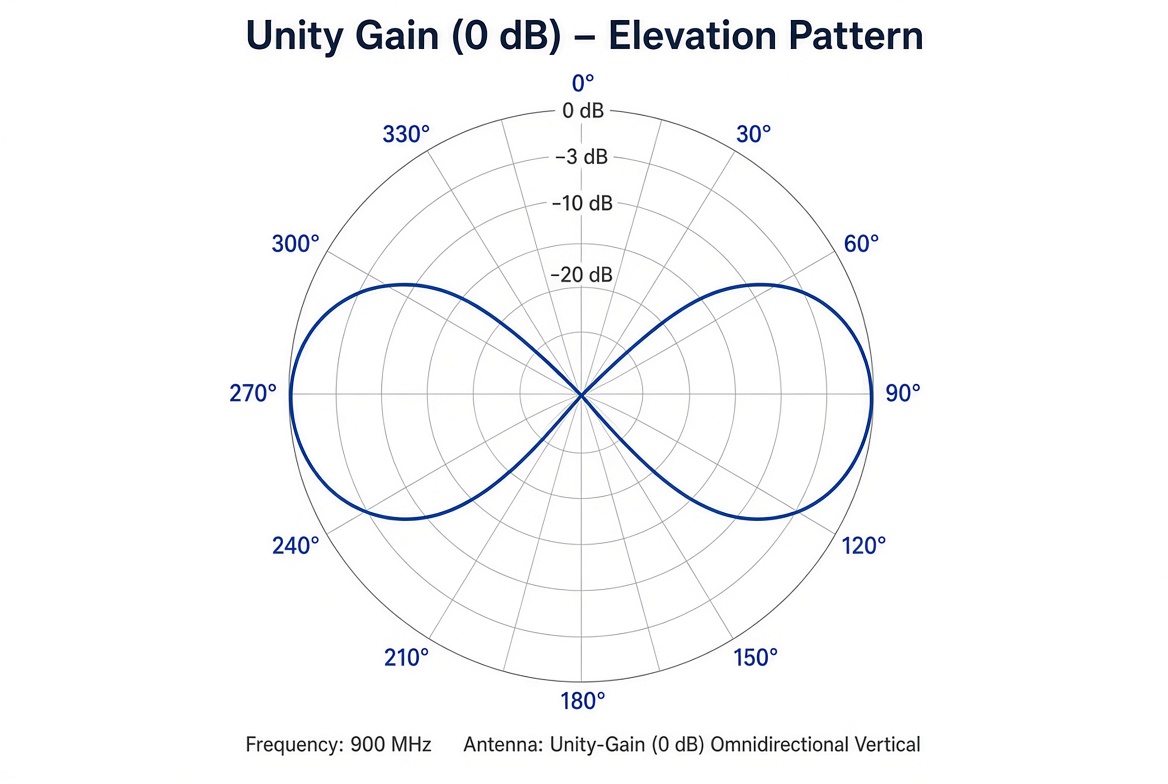
Classic broad figure-eight pattern
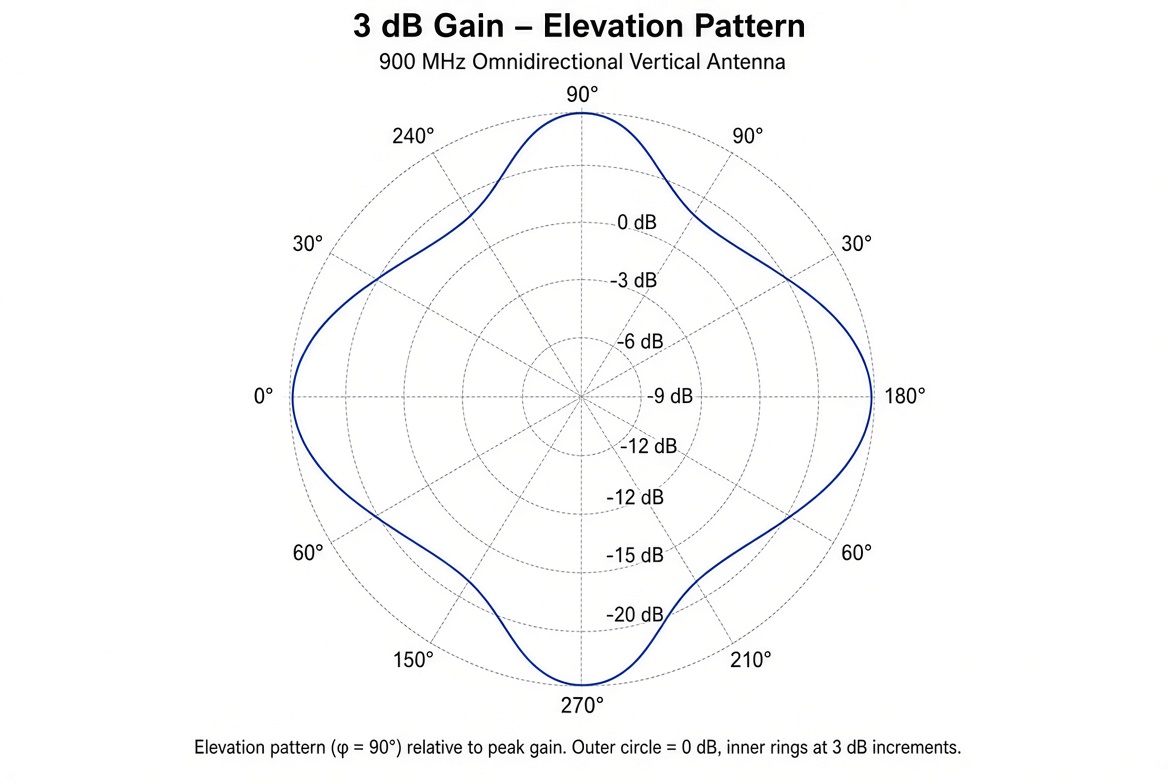
Slightly flatter, more energy toward the horizon
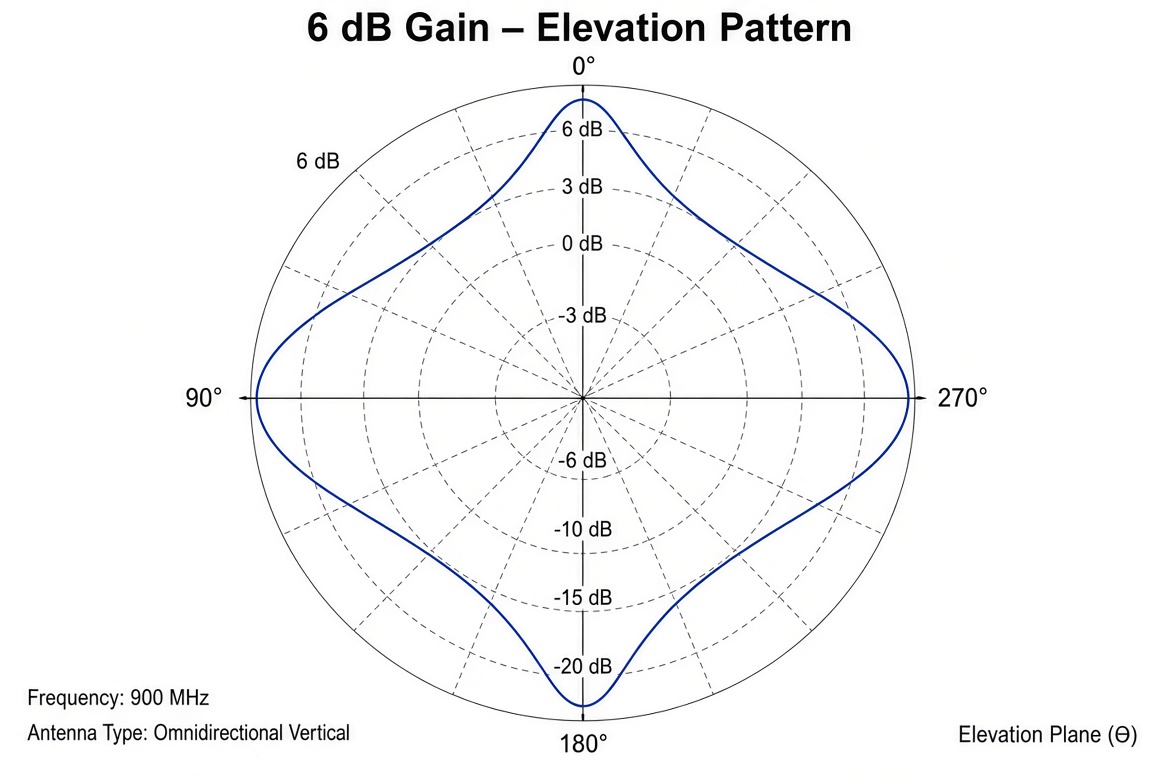
Noticeably compressed toward the horizon
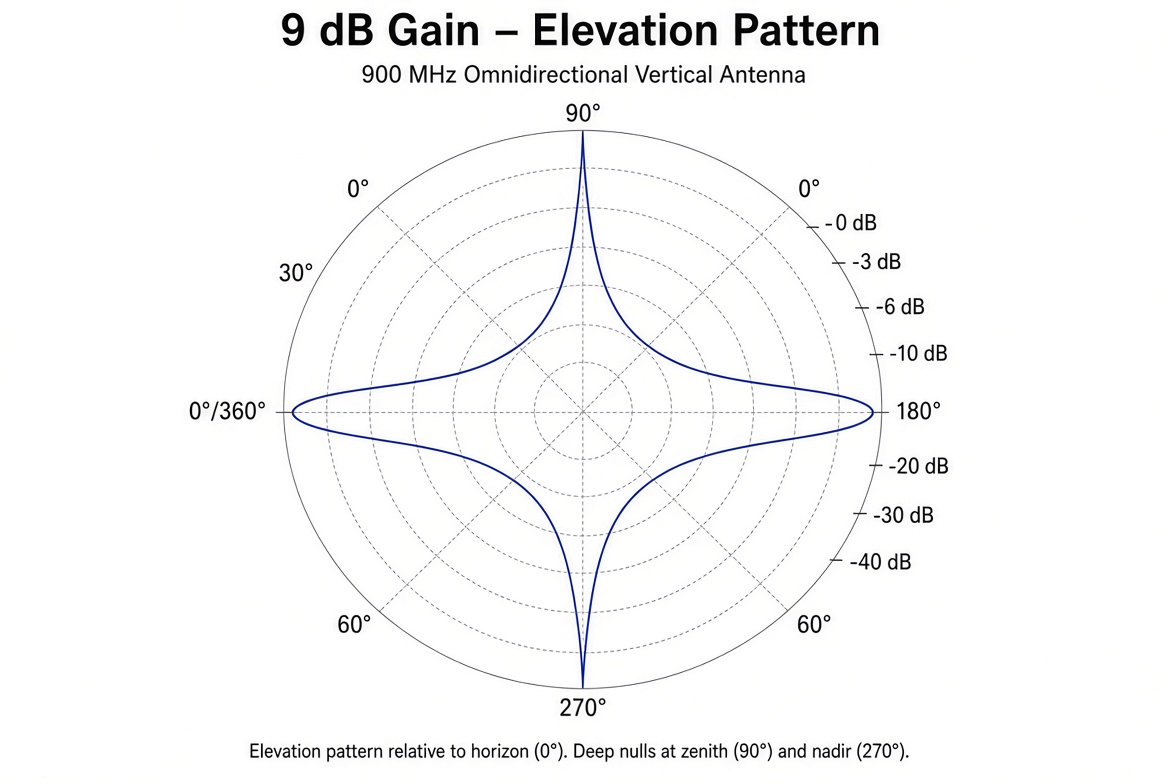
Very flat, most energy near the horizon
These patterns are representative of common omnidirectional vertical antennas. Actual patterns vary by design, but the trend is consistent: higher gain narrows the vertical beamwidth and directs more energy toward the horizon.
Understanding dBi and dBd
Antenna gain is usually listed in one of two units: dBi or dBd. Both describe how much an antenna concentrates signal compared with a reference, but they use different reference antennas, so the numbers are not interchangeable.
- dBi (decibels relative to an isotropic radiator) compares the antenna to a theoretical antenna that radiates equally in every direction — a perfect sphere of energy. No real antenna works this way; it is a mathematical ideal used as a common baseline.
- dBd (decibels relative to a dipole) compares the antenna to a simple half-wave dipole antenna. A dipole is a real, buildable antenna that already focuses energy somewhat (mainly toward the horizon when mounted vertically) and is a common practical reference in radio work.
Because a dipole already has some gain compared with the theoretical isotropic antenna, dBd numbers are lower than the equivalent dBi numbers. As a rough conversion:
- dBi ≈ dBd + 2.15
- dBd ≈ dBi − 2.15
For example, an antenna advertised as 5 dBi is roughly the same as one advertised as 2.85 dBd.
Which is closer to real-world performance?
Neither unit changes how the antenna actually behaves — they are just different ways of measuring the same thing. However, dBd is often a more intuitive real-world reference for MeshCore and similar radio use. A half-wave dipole is a practical antenna that many people can visualize or even build, and most of the antennas used with companions and repeaters are compared against that kind of everyday performance. dBi, by contrast, is measured against a perfect antenna that does not exist, so the numbers look higher even though the actual radiated signal is identical.
When comparing antennas, make sure you are looking at the same unit. Many manufacturers list gain in dBi (which produces a larger-looking number). If a specification only shows dBd, the gain relative to an isotropic antenna is a little higher than the printed figure, but the real-world improvement over a simple dipole is exactly what the dBd number states.
In everyday MeshCore use, the most common improvement still comes from getting a reasonable antenna higher and clearer of obstacles. Understanding gain, directivity, and the difference between dBi and dBd simply helps you choose an antenna that matches the coverage pattern you actually need, rather than assuming “higher gain is always better.”
Practical Placement Considerations
When choosing where to put an antenna (whether on a companion or a repeater), keep these points in mind:
- Elevation helps — Higher ground or a taller mast generally extends range, especially in rolling or wooded terrain.
- Clear the immediate surroundings — Even a good antenna loses effectiveness if it is surrounded by metal, dense trees, or the side of a building.
- Vertical is usually best — Most MeshCore antennas are designed to be mounted upright. Tilting or laying an antenna on its side reduces performance in most situations.
- Cable loss is real — Long runs of coaxial cable between the radio and the antenna can weaken the signal. Keeping the cable as short as practical, or using lower-loss cable for longer runs, preserves more of the radio’s power.
Companions vs. Repeaters
The same principles apply to both, but the stakes are different:
- For a companion, a modest antenna improvement can make day-to-day use more reliable without any other changes.
- For a repeater, antenna height and placement directly affect how many other stations the repeater can usefully serve. A repeater with a poor antenna location may forward very little traffic even if the radio itself is working correctly.
Good antenna placement is one of the highest-leverage improvements you can make. The next lessons cover how regions help control traffic and how to keep a repeater powered once the site is chosen.
← Previous: Understanding Repeaters
Continue to: Powering Your Repeater →
Was this material helpful? Leave feedback or suggest a correction.