MeshCore is a decentralized communication system built around LoRa radios. Instead of relying on cell towers, internet service, or a central server, MeshCore devices communicate directly and through other radios in the network to move messages across an area.
How MeshCore Works
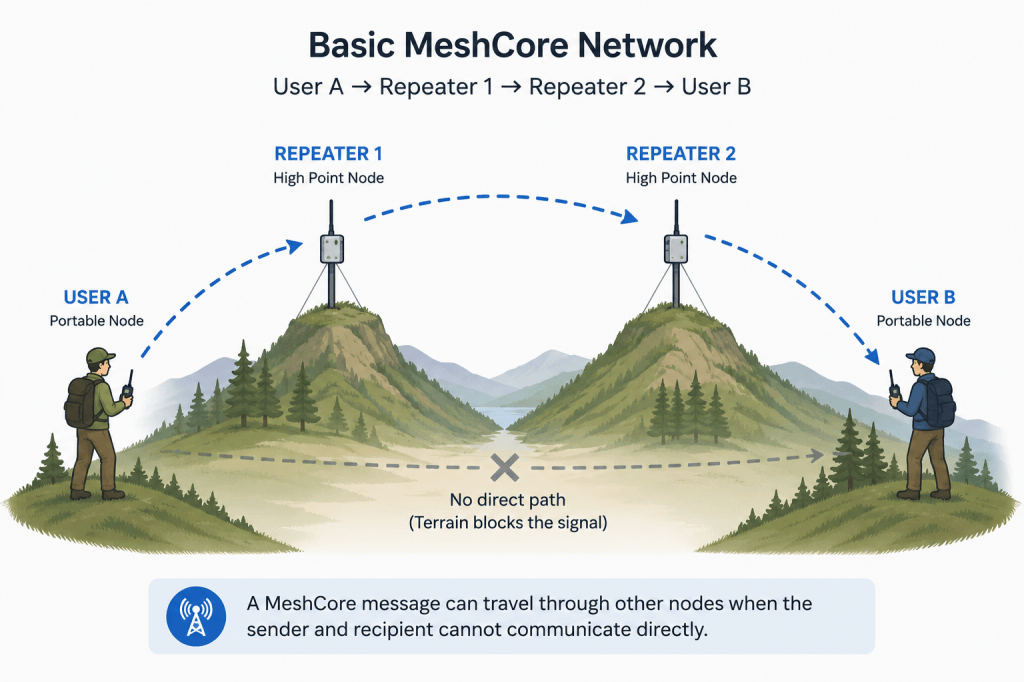
A MeshCore network is made up of individual LoRa radios called nodes. Some nodes are carried by users, some remain at fixed locations, and others operate as repeaters positioned where they can extend communications over a larger area.
When a message cannot reach its destination directly, other MeshCore nodes can help move that message through the network. This ability to communicate from node to node allows coverage to extend well beyond the range of a single radio.
A Network Without Central Infrastructure
Traditional communication systems usually depend on infrastructure such as cellular towers, internet connections, or centralized servers. MeshCore takes a different approach. The radios themselves form the communication network, allowing messages to move between devices without requiring an internet connection.
This does not mean every MeshCore radio must be able to hear every other radio. A well-placed repeater can connect users and areas that would otherwise be beyond direct radio range. As additional repeaters and users join the network, the practical coverage area can grow.
The Different Roles in a MeshCore Network
MeshCore devices can perform different roles depending on how they are used. A radio carried by a person does not necessarily perform the same job as a repeater installed on a mountaintop or a device used to provide network services. Understanding these roles makes the rest of MeshCore much easier to understand.
Companion
A companion is the MeshCore device a person normally interacts with to send and receive messages. It connects to a phone, tablet, or computer running a MeshCore companion app, which provides the screen and controls used to communicate with the network.
The companion contains the LoRa radio that actually communicates over the air. Depending on the hardware, the connection between the companion and the user’s device may use Bluetooth, USB, or another supported connection.
Repeater
A repeater is a MeshCore device whose primary job is to help messages travel farther through the network. Rather than serving as the user’s everyday messaging device, it listens for MeshCore traffic and retransmits appropriate messages so they can reach other radios.
Repeaters are most effective when installed where they have good radio coverage. A repeater placed on a hill, tower, tall building, or other elevated location may communicate with nodes across a much larger area than a radio operating near ground level.
Room Server
A room server is a MeshCore device that provides a persistent place for users to exchange messages. Unlike a repeater, whose primary purpose is moving traffic through the mesh, a room server provides a shared messaging service that users can connect to and use.
Because the room server remains available even when individual users come and go, it can provide continuity for a group or community. Messages and access are handled by the room server rather than depending entirely on two users being available to communicate with each other at the same time.
How Messages Move Through MeshCore
When a MeshCore user sends a message, the radio transmits it over LoRa. If the intended destination can be reached directly, communication may occur without another node in between. When direct communication is not possible, repeaters can help carry the message across the network.
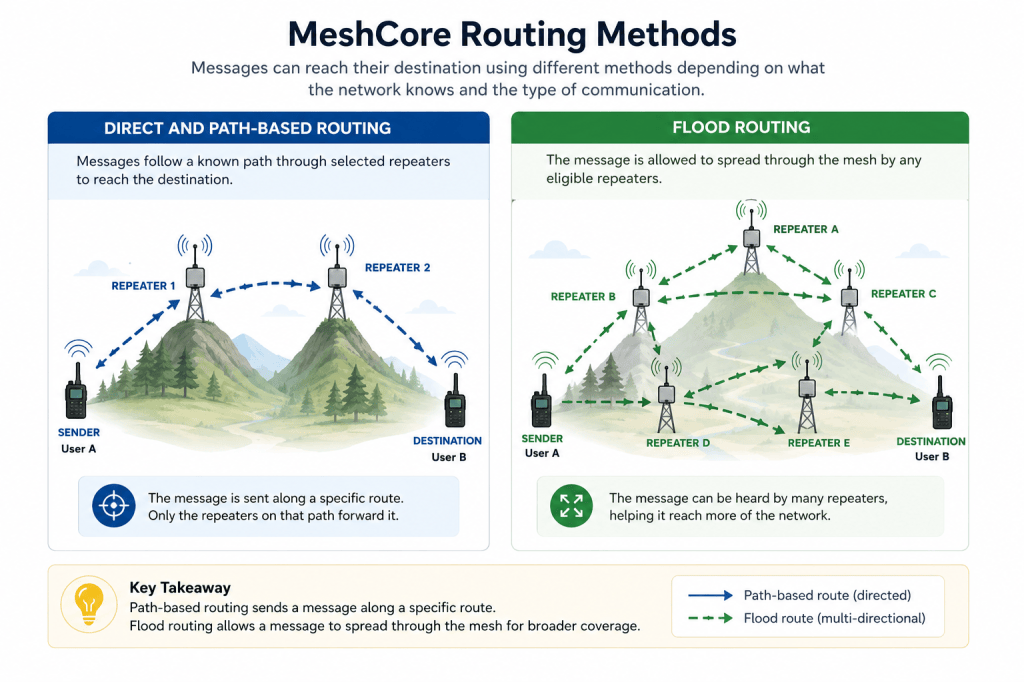
MeshCore uses different methods for moving messages depending on the type of communication and what the network knows about the destination. Some messages may follow a known path, while others may be distributed more broadly through the mesh. These methods are known as direct/path-based routing and flood routing.
Direct and Path-Based Routing
When two MeshCore devices can communicate directly, a message can travel from the sender to the destination without using a repeater. When the destination is farther away, MeshCore can use a known path through one or more repeaters to reach it.
A path identifies the repeaters that should carry the message toward its destination. Instead of asking the entire mesh to retransmit the message, the transmission can be directed through the repeaters that make up that path. This can reduce unnecessary radio traffic and make more efficient use of the network.
Flood Routing
Flood routing takes a different approach. Rather than following a predetermined path, an eligible repeater that receives the message may retransmit it so the message can continue spreading through the mesh.
This is useful when a specific path is not known or when a message is intended for multiple users, such as traffic on a shared channel. Because multiple repeaters may participate, flood routing can provide broad coverage, but it can also create considerably more radio traffic than path-based communication.
Why MeshCore Is Different
MeshCore is designed to let people communicate over a radio network that can operate independently of cellular service and the internet. The network is formed by the radios themselves, so communication can continue anywhere suitable MeshCore devices can establish radio links with one another.
Unlike systems that depend on a central tower or server to carry every message, a MeshCore network can grow as additional users and repeaters are added. A strategically placed repeater can connect areas that individual users could not reach directly, while multiple repeaters can extend communication across a much larger region.
This makes MeshCore useful for local communities, outdoor activities, events, emergency or backup communications, and experimentation with decentralized radio networks. The size and effectiveness of a MeshCore network ultimately depend on factors such as terrain, antenna placement, radio coverage, and how the network is designed.
Where We Go From Here
Now that you understand the basic idea behind MeshCore, the different roles devices can perform, and the two basic ways messages move through the network, the next step is choosing the hardware you will use. In the next lesson, Choosing Your First MeshCore Device, we’ll look at the common types of MeshCore hardware and how to select a device that fits what you want to do.
Continue to: Choosing Your First MeshCore Device →

